Last summer I attended the American Dahlia Society Show in Portland. I saw lots of lovely dahlias and listened to several educational lectures on growing dahlias. One of the hot topics was bugs and slugs that eat dahlias. I shrugged. I have ducks. I don’t have slugs or bugs. My ducks occasionally nibble a dahlia leaf, but since the dahlias are all in raised beds, the ducks don’t bother them much.
This experience is the summary of the whole story of pests in my garden. I have ducks. I don’t need sprays for bugs or poisons for slugs. My current flock consists of seven muscovy ducks. They keep the acre inside the deer fence clean. They eat slug eggs along with the adult slugs and most other creepy crawly things.
In addition to the benefit of pest control with very little effort on my part the ducks are amusing to watch. I’m afraid mine are a bit spoiled. My backup for slug control is beer traps. Before the ducks had the slug problem under control, I would set out beer traps. Before long, I noticed the beer traps were tipped over with no sign of dead slugs. Puzzled, I started watching the traps. We’d let the ducks out to forage in the morning, and they would run straight to the beer trap, knock it over, and feast on the marinaded slugs. I guess we can’t blame them, although I doubt the beer was all that good. I was using the cheapest I could find.
My ducks are also good for weed control. I throw a bit of cracked corn on the ground in an area where the weeds are bad and they clean it out in a couple of days. They’ll eat anything green and trample what’s left. They’re good with grass-type weeds. I haven’t pitted them against Himalayan blackberries. For those, you might need chickens.
I love the idea of chickens in the backyard for entertainment and pest control. The problem with chickens is that they scratch. They get into a garden bed and throw dirt in every direction, so they need to be fenced away from vulnerable planting. When I was a child, my dad built the chicken pen around a patch of blackberries and let the chickens clean them out. You may need to help the chickens a bit by pruning out some of the bigger canes, but the chickens will scratch out the roots, leaving you a clean patch of fertilized ground that can be turned into a new garden bed after you fence the chickens into a different problem area.
In addition to pest control, backyard poultry also supply us with fresh eggs and something much, much more valuable—poop.
I mulch my gardens with rotted straw litter from the duck yard. It doesn’t take long for the litter to break down after the ducks have used it. It does tend to be high in phosphorus, so I have to be careful not to over-feed my beds. However, it does make an ideal mulch. If I want to get rid of invasive weeds, fresh litter from the duck yard will kill them. I also use it fresh in lasagna beds to help break down the cardboard layer and kill weed seeds in the soil. Afterward, though, I do need to let the bed sit a bit before I attempt to plant seedlings or they’ll burn and die from the fresh litter.
We’ve also had geese. Our old gander, Basil was good at weeding and guarding the ducks. He was a great help in my war against invasive buttercup. I’d have to do the first round of weeding, but once the soil was loose, Basil would go through and pull anything that came up after I was done. Of course, he didn’t know the difference between invasive buttercup and ageratum. I found a few seedlings pulled out of their holes before I learned to let a bed sit until Basil lost interest in it before setting out seedlings.
While poultry are helpful and ornamental in the landscape, they do have one huge problem—predators. We’ve lost poultry to raccoons, coyotes, mink, and bald eagles. It’s heartbreaking.
We originally fenced in an acre to contain our two standard poodles. A fence has to be pretty sturdy and cleverly constructed to keep a standard poodle confined. I’m pretty sure a coyote can’t get in through the fence unless a gate is left open. Gates get left open.
A fence isn’t much of a deterrent to a raccoon, and a bald eagle may not know it’s there. We also needed a secure prison inside the poodle fence for the poultry. I wanted a nice sturdy barn with a concrete floor. I don’t know where I’d put it, but that was my fantasy.
Since I don’t have a barn, I made a poultry pen out of 6’ x 8’ welded-wire panels. I put welded wire along the ground so nothing can dig under. I have hardware cloth along the lower half of each panel to keep raccoons from reaching through the wire. The peaked, wood roof is covered with a tarp that comes down the sides. I’ve wrapped black landscape fabric around the outside over the welded wire to keep out rats and smaller critters. Is this ugly as sin? Yup, especially when Hubby decides to replace my brown or green tarp with a bright blue tarp. The system seems to be working to keep predators out of the poultry pen. A barn would be so lovely.
Last year, I protected the grape crop from raccoons, using motion activated laser lights that flash and emit an annoying sound. The raccoons didn’t get our grapes. Since the little battery-operated deterrents seem to work, I added them to my arsenal to protect my poultry.
I have a decent, if ugly, system for protecting the poultry from things that walk upon the earth. What about the things that fly? We have a bald eagle that cases-out our yard regularly. He isn’t shy about coming right up to the front door to grab a duck that is trying to get into the house through the cat door. Really! One day, I heard a ruckus in the front hall and found frightened ducks popping and pooping through the cat door onto the pristine entry hall floor, then I opened the door to come face to face with a bald eagle. The eagles haven’t attacked Hubby or me yet, but I can see them sizing us up for dinner. Our eagle has a routine of going fishing off Pt. Defiance every morning. If he hasn’t caught anything by ten AM, he circles back over my yard to see if he can find some nice fat poultry.
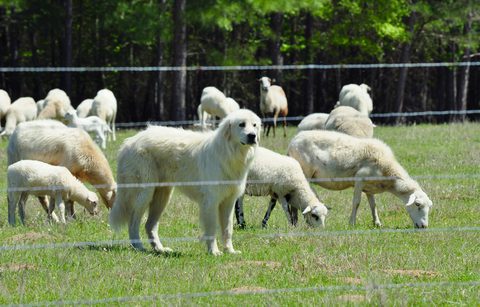
In the past, we’ve had dogs to deter the eagle. Our old dog passed away last fall. So far, we haven’t had any trouble with the eagle, but we don’t let the ducks out to forage if we’re not here to protect them—not that I want to tangle with the eagle. He’s huge, and he looks mean, but the rewards of having sustainable garden practices and constant garden entertainment make having a few birds to help in the garden well worth the risk and the effort they take.

Author: Delinda McCann
Delinda McCann is the owner of the Burton Flower Stand, a retired social-psychologist and a writer. She’s lived on Vashon for over forty years. She’s an organic grower working with all the challenges of Vashon soil, including clay under a sand and gravel layer and fallout from ASARCO—no topsoil. She is an experienced combat veteran in the war against foraging deer and invading raccoons.